
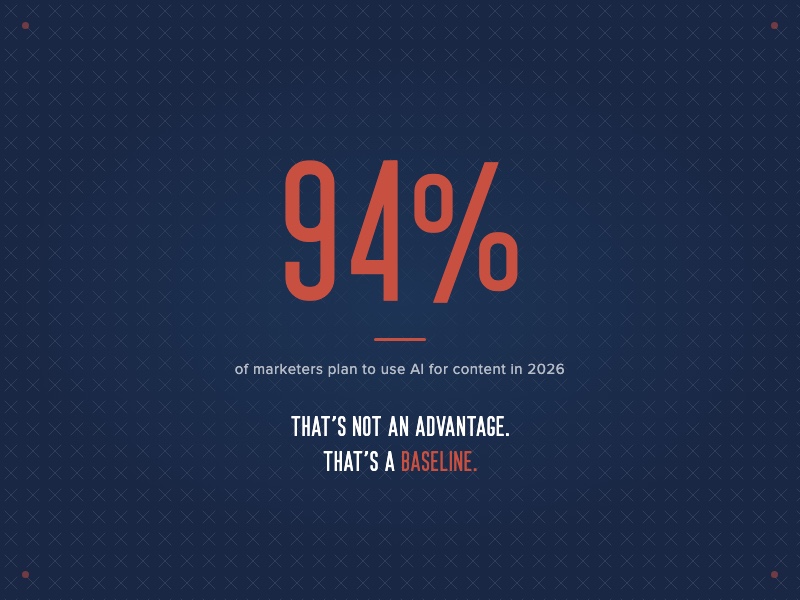
Ninety-four percent of marketers plan to use AI to create content in 2026. Sit with that number for a second. It does not describe an advantage anymore. It describes a baseline.
For two years, the pitch has been that AI is a competitive edge. Faster blogs, cheaper email, personalized ad variants at a scale no human team could touch. That was true for the early adopters. It stopped being true the moment your competitor down the street signed up for the same tools and typed the same prompt into the same model.
The Problem Nobody Wants to Say Out Loud
When everyone uses the same handful of foundation models, fed by roughly the same instructions, the output converges. Not toward brilliance. Toward the middle.
There is a name for this in the data world. Sir Francis Galton’s famous 1906 experiment had 800 fairgoers guess the weight of an ox. Any single guess was wildly off, but the median of the crowd landed within one percent of the real weight. Aggregation finds the average, and the average is uncannily accurate. That is a beautiful thing when you are estimating an ox. It is a disaster when you are trying to sound like anyone other than every other apartment community in your submarket.

That is what a large language model does by design. It predicts the most probable next word. Probable is the enemy of distinctive. So when a hundred properties ask AI to “write a blog about pet-friendly amenities in a luxury community,” they do not get a hundred voices. They get a hundred versions of the same voice, and renters can feel the sameness even when they cannot name it.
The industry already has its cautionary tale. Coca-Cola replaced its beloved 1995 holiday campaign with roughly 70,000 AI-generated video clips produced in 30 days. The internet called the result “soulless” and “creepy.” That was Coca-Cola, with the biggest brand budget on earth. The lesson scales down brutally to a regional operator running five communities.
The Reframe: Efficiency Was Never the Prize
Here is the shift Criterion.B wants you to make before your next content budget conversation.
For 2026, differentiation has quietly overtaken efficiency as the top priority for serious marketing teams. The reason is simple economics. When a capability becomes universal, it stops commanding a premium. Generic content is now effectively free to produce, which means it is now effectively worthless as a differentiator. You cannot win on the thing everyone can do in ten seconds.
The scarce asset is no longer production. It is point of view. Information is a commodity now; a chatbot will hand any renter a tidy summary of your floor plans and your neighborhood without ever visiting your site, which is exactly why your best leads are increasingly arriving pre-qualified from AI. A point of view is proprietary. It is the one thing that cannot be averaged out of a training set, because it was never in the training set to begin with.
This is why “bespoke” and “personalized” are coming back into the language of high-end marketing. Not as nostalgia. As strategy.
What “Personalized” Actually Means Now
Be careful here, because the industry is about to misread this trend in an expensive way.
Most multifamily marketers hear “personalization” and reach for the mechanical version: first-name tokens in the email, dynamic ad variants by persona, chatbots that greet a lead by name. That is fine. It is also table stakes, and it is getting commoditized faster than anything else, because it is exactly what the tools are built to automate. When every property can spin up “personalized at scale” with one click, personalized at scale differentiates no one.
Real personalization in the post-AI landscape is specificity that the model cannot fake. It is the content only you could have written because it is true only of your community:
- The actual reason the couple in unit 214 chose you over the property with the nicer gym and what that tells you about who you are really for.
- The neighborhood detail no listing site knows: which coffee shop your residents actually walk to, why the Tuesday farmers market matters, what the light does in the courtyard at 6 p.m. in October.
- A genuine position on something (pet policies, remote-work amenities, how you handle renewals) stated plainly enough that some renters self-select out. A brand that is for everyone reads, to an AI and to a human, as for no one.
None of that comes out of a prompt. It comes out of knowing your community and having the nerve to say something specific about it. AI can help you produce it faster, structure it, clean it up. It cannot originate it. That is the whole point.
The Implication for Decision-Makers
The uncomfortable truth is that AI has raised the floor and lowered the ceiling at the same time. It has made mediocre content trivially easy, which means mediocre content no longer earns attention, a click, or a lead. The bar for “good enough” just moved, and it moved up.
So the question to bring into your next planning meeting is not “how do we produce more content with AI?” Everyone is asking that, and everyone will arrive at the same forgettable answer. The better question is: what do we know, believe, or stand for that no model could generate on its own and are we brave enough to build our content around it?
That reframe also changes how you get found. As renters increasingly start their search inside AI assistants rather than search bars, the properties that surface are the ones with a clear, credible, specific signal; not the ones drowning in interchangeable copy. Distinctiveness is no longer just a brand nicety. It is becoming a discovery strategy.
The Close
The agencies and operators who win the next few years will not be the ones with the best AI. Everyone will have the same AI. They will be the ones who use it to move faster on the work that was always the hard part: figuring out what is genuinely, specifically, defensibly true about their brand, and saying it in a voice a machine could never average its way into.
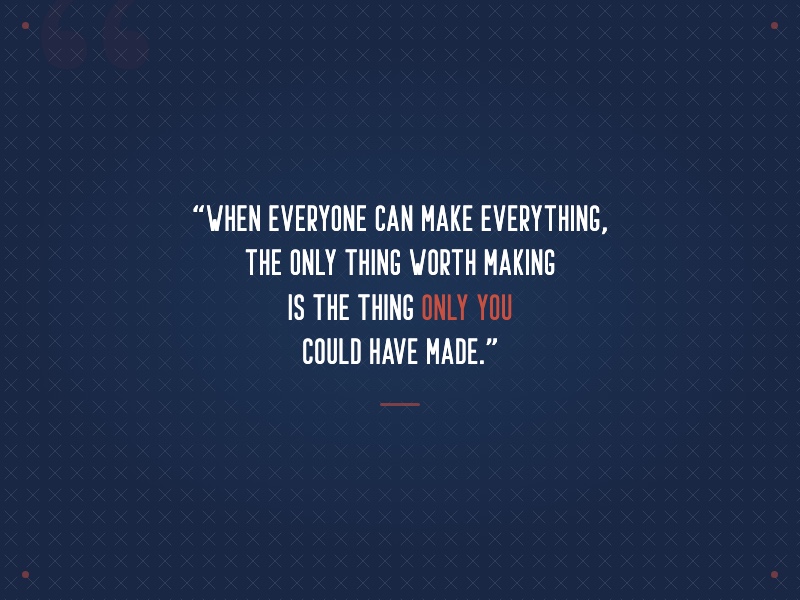
When everyone can make everything, the only thing worth making is the thing only you could have made.
Share This Article


Subscribe to our newsletter
Related Blog Posts