
A renter opens ChatGPT at 9:47 p.m. and types: “Best 1-bedroom apartments in Austin under $2,000, with a pool, that are running move-in specials.” Forty seconds later, she has a clean list of five properties. Each is offering six weeks free. Each is within $50 of the next. Your community is on the list. So is everyone else’s.
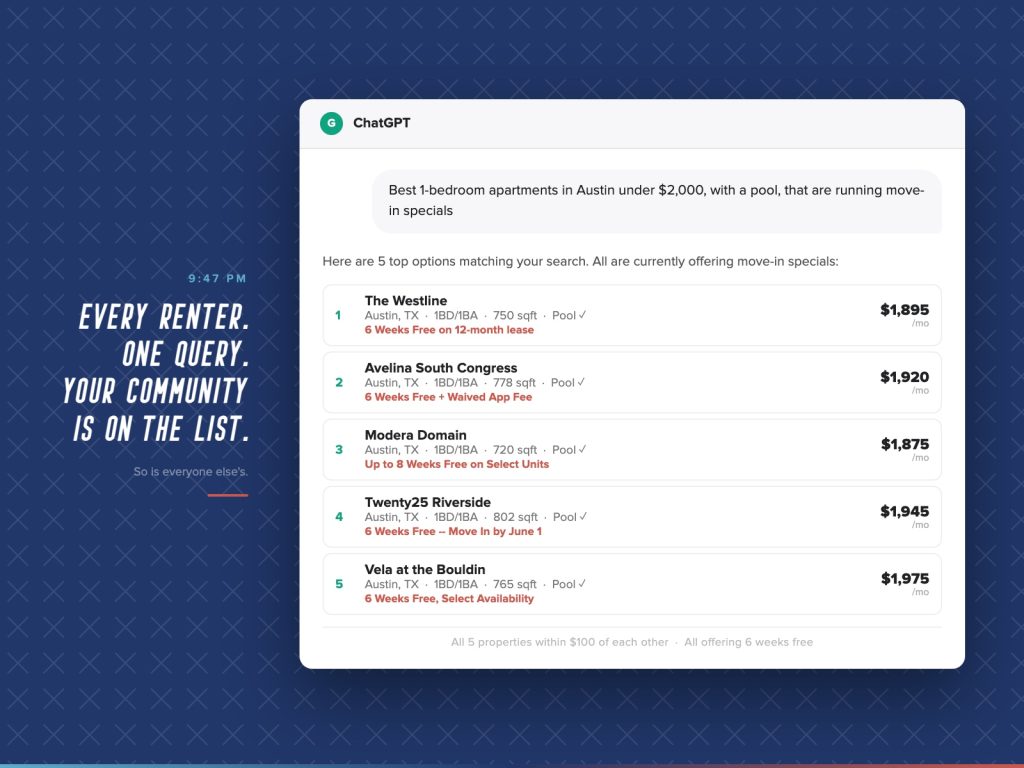
That moment, repeated thousands of times a night across every metro in the country, is the quiet end of concessions as a marketing strategy.
The Concession Trap Has a New Accelerant
Concessions have always been a tactical lever, not a strategic one. You drop a month free to fill a stubborn building, lease velocity ticks up, you breathe. The math worked because the information environment was friction-rich. Renters saw your specials in a Zillow listing one day and a Google result the next. Comparison was slow, partial, and emotional.
That world is gone.
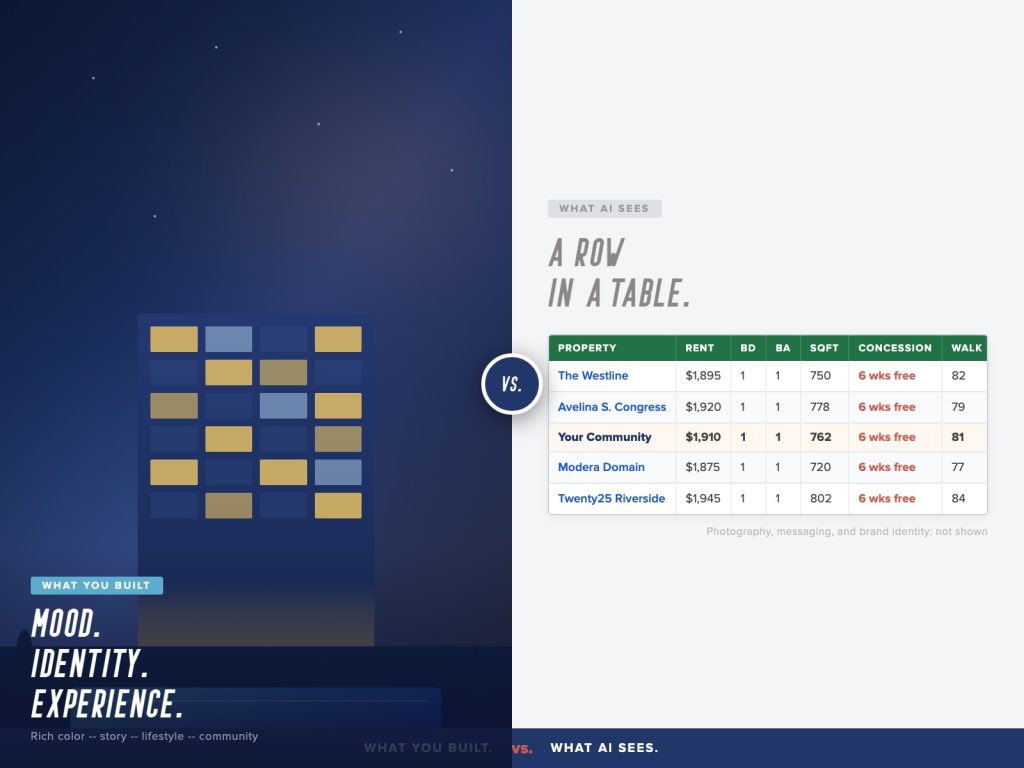
What used to take a renter two weeks of touring and spreadsheet-building now takes one prompt. Perplexity, ChatGPT, Gemini, and Zillow’s own AI overlays don’t just surface listings. They normalize and rank them. They strip out your photography, ignore your messaging, and reduce your community to a row in a comparison table: rent, beds, baths, square footage, concession value, walk score.
In oversupplied Sun Belt markets like Austin, Nashville, and Phoenix, concession activity climbed sharply through 2024 and into 2025, with stabilized Class A properties widely advertising six to ten weeks free. RealPage and Yardi Matrix have both flagged it as one of the defining features of recent lease-up cycles. The problem isn’t that concessions stopped working. The problem is that they’re working for everyone, simultaneously, and AI is what made that simultaneity possible.
When every competitor matches your concession within a week, and an AI tool surfaces all of you in the same query, the lever doesn’t just lose its edge. It anchors your community to a price war you didn’t choose to enter.
AI Has Made Price the Worst Battlefield to Fight On
Here is the uncomfortable truth most operators haven’t fully internalized: price-and-concession competition is the one battlefield where AI most efficiently erases your advantage.
Algorithms are good at comparing things they can quantify. Concessions are quantifiable. So is rent, square footage, amenity count, distance to a Whole Foods, walk score, and rating averages. The more legible a feature is to a machine, the faster it gets compared, ranked, and commoditized. Anything you can put in a feed, an AI can flatten.
The implication is strategic, not tactical. If your differentiation lives entirely in the columns AI can read, your differentiation is now a liability. You will be compared, ranked, and filtered against twenty other properties that look almost identical on paper. The only remaining variable becomes price. That’s the concession paradox: the more you compete on the lever AI can quantify, the more you accelerate the race that erodes your margins.
This is also why concession-heavy markets often see compressed rent growth even after lease-up stabilizes. The discount discipline never fully resets. Renewal renters have already been trained to expect it. New renters have already seen comparable buildings advertising it. The concession becomes the new reference point, not the exception.
What Machines Can’t Compute (Yet)
Now consider what the same AI tool struggles to compare: the way the lobby smells when you walk in on a Sunday afternoon. The fact that the leasing team remembered your dog’s name from the tour. The mural in the parking garage. The Friday morning coffee cart. The unspoken sense, walking through a community for fifteen minutes, that “this is a place for someone like me.”
These aren’t soft qualities. They’re emergent ones, properties of a system that don’t reduce cleanly to data fields. AI models can summarize reviews. They can scrape testimonials. They can parse photography. But they cannot reliably encode the felt experience of a place into a comparison cell. They cannot tell a renter, “this one will feel more like home.” That’s a verdict the renter has to render in person, with their nervous system, in real time.

This is the only defensible territory left in an AI-optimized rental market.
The Identity Moat
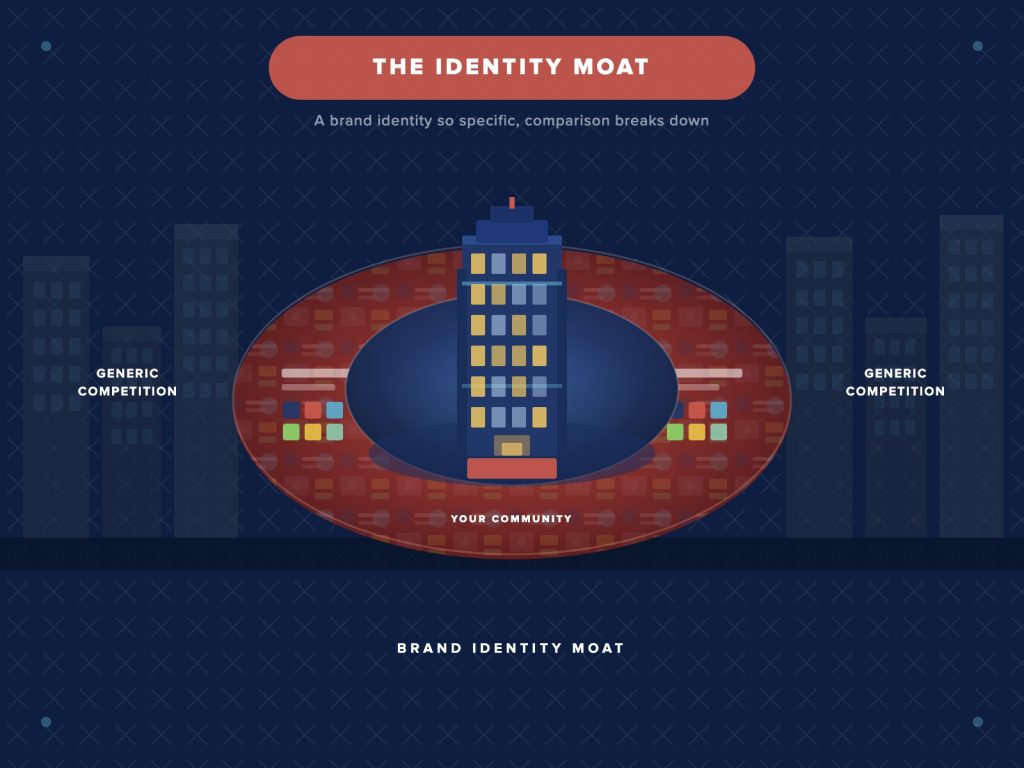
Call it the Identity Moat: a brand identity specific enough and emotionally resonant enough that comparison breaks down. A community sitting inside an Identity Moat doesn’t show up on a renter’s list as one of twelve interchangeable buildings. It shows up as a destination. The renter stops asking, “is this the cheapest option?” and starts asking, “is this the right one?”
This isn’t hypothetical. It’s how the most pricing-resilient brands in adjacent industries already operate. Equinox charges three to four times what a typical gym charges, and the people who pay it would describe themselves as Equinox members before they’d describe themselves as gym members. Soho House sells belongings, not square footage. Erewhon charges $20 for a smoothie because the smoothie is incidental. The identity is the product.
In multifamily, the operators inching toward this model are usually the ones building a portfolio brand with a clear point of view. Sentral and Common engineered identity into the leasing experience from day one. Mill Creek’s Modera, Bozzuto’s portfolio voice, and AvalonBay’s segmented sub-brands (AVA, Avalon, eaves) are all attempts, at different levels of conviction, to manufacture an Identity Moat at scale. The best of these communities have residents who say, unprompted, “I’d pay $200 more to live here.” That sentence is the only one in this entire conversation that matters.
What an Identity Moat Actually Looks Like in Practice
A real Identity Moat is built from three things: a clear point of view about who the community is for, a consistent expression of that point of view across every touchpoint, and a willingness to disqualify the renters who don’t fit it.
The third one is where most operators flinch. A brand that tries to appeal to everyone reads, to an AI and to a renter, as a brand for no one. The communities that command pricing power are usually the ones that have made a confident, specific bet about their resident profile and built the entire experience around that bet. The mural in the parking garage isn’t decoration. It’s a signal. So is the music in the leasing office, the language on the website, the type of partnership the property has with the neighborhood coffee shop, and the personality of the leasing team.
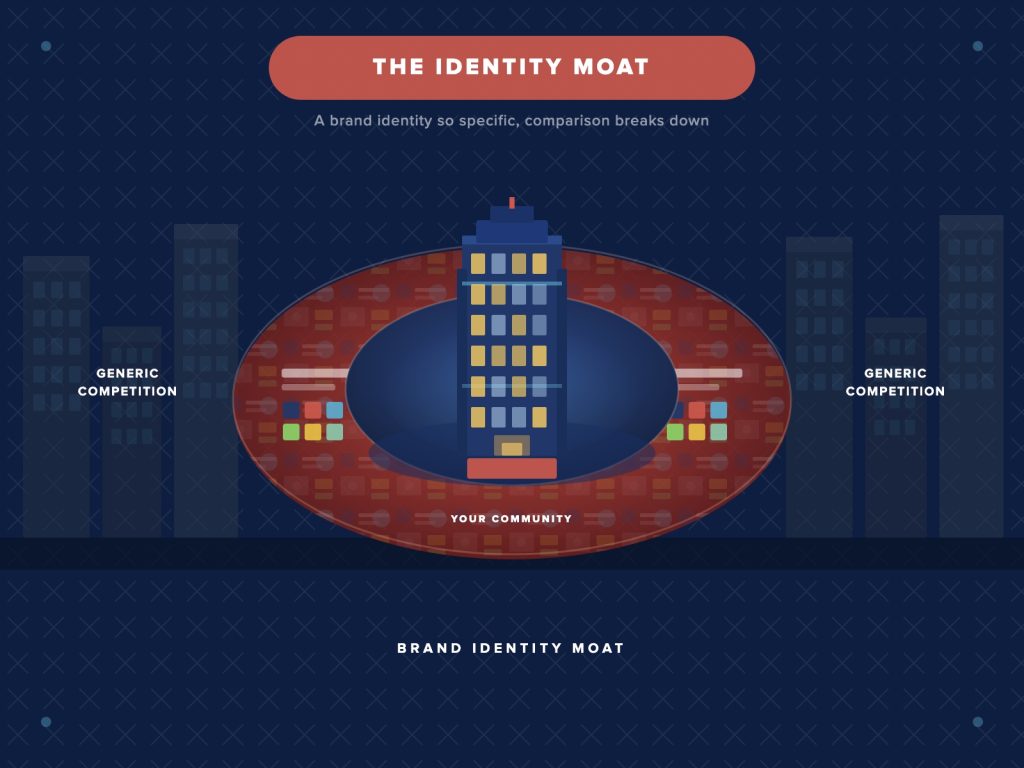
When those signals stack consistently, something unusual happens. The community becomes harder to substitute. A renter who has decided “this is my place” stops shopping, stops comparing, and stops opening AI search tabs. The Identity Moat hasn’t just protected pricing. It’s removed the renter from the comparison game altogether.
The Strategic Stakes Heading Into 2026
For CMOs and marketing directors heading into 2026 budget conversations, this reframes a question that’s been quietly miscategorized for years. Brand investment isn’t the soft, “nice to have” line item cut when concessions need funding. In an AI-optimized market, brand is the only line item that meaningfully insulates rent. A 6% concession on a 300-unit Class A community can erase low-seven-figures of NOI in a single lease-up year. Marketing teams that credibly trade some of that concession spend for an investment in identity will outperform the ones still treating brand as decoration. That isn’t a soft argument. It’s a CFO-grade one.
The renter on ChatGPT at 9:47 p.m. is going to keep asking the same question. The communities that win in 2026 won’t be the ones with the longest list of specials. They’ll be the ones the AI can’t quite explain. The ones the renter has to go see for herself, and walks out wanting.
Share This Article


Subscribe to our newsletter
Related Blog Posts