

The New SEO Battleground: Answers vs. Authority
The digital landscape has fundamentally changed. The goal of SEO is no longer just to get a blue link on the first page; it’s to be the definitive, trusted source for information, whether that source is read by a human or synthesized by an AI model.
If you’ve been paying attention, you’ve seen these acronyms everywhere: AEO and GEO. They sound interchangeable, but treating them that way is a critical mistake that will cost you visibility in the coming years.
AEO (Answer Engine Optimization) and GEO (Generative Engine Optimization) are both modern extensions of your current SEO strategy, but they serve two distinct purposes. One helps you win the quick answers; the other helps you win long-term authority.
What Is AEO (Answer Engine Optimization)?
AEO is a content strategy designed to help your site appear as a direct, instant answer in search results.
AEO focuses on optimizing content for platforms such as Google’s Search Generative Experience (SGE), voice assistants, and AI-driven tools like ChatGPT.
You see AEO in action every day: Google’s featured snippets, “People Also Ask” (PAA) boxes, and even voice assistant responses. Search engines shifted years ago from simply listing links to directly answering user questions. AEO helps your content align with that shift.
How AEO Works and Why It Matters
AEO focuses on creating content that is clean, relevant, and easy for search engines to parse. It aims to deliver information quickly and concisely to the user.
- Structure Is King: AEO content is structured around specific, searchable questions. You use headers that mirror the way people search (e.g., “What is the average cost of X?”), followed immediately by a short, definitive answer (aiming for 2-4 sentences).
- Targeting High-Intent Queries: AEO excels at targeting short, high-intent keywords such as product comparisons, pricing questions, or step-by-step instructions.
- Technical Signaling: Implementing schema markup, such as FAQ or HowTo, is crucial for AEO, as it signals to search engines that your content is structured for rich results.
The takeaway: AEO helps you meet users exactly when they need a fast answer. It gives your site a shot at winning the zero-click answer space, appearing before competitors even get a click on a traditional blue link.
What Is GEO (Generative Engine Optimization)?
GEO addresses the fundamental change in how AI-powered search engines now generate answers.
With GEO, you position your content as a trusted, citable source that generative AI systems use to build comprehensive summaries. This is critical for visibility on platforms such as Google’s AI Overviews and Bing’s Copilot.
Instead of merely listing links or pulling short quotes (AEO), generative AI models summarize information from multiple, trusted sources, often without sending a click your way. Your goal with GEO is to ensure your content is a trusted source.
What Matters Most for GEO
In an era where generative AI is at our fingertips, is original research still worth the investment? Or are we headed toward a future where SEO is simply about who can produce content the fastest?
GEO is less about formatting and more about Authority, Expertise, and Completeness (E-E-A-T). You’re not just trying to rank; you’re trying to be the source the machine trusts.
This is where the real power of original research comes in; it doesn’t just help SEO; it builds brand authority in SEO and thought leadership.
- Long-Form Authority: GEO favors comprehensive, helpful content that answers complex topics completely. If your content lacks depth, an AI will simply use a competitor’s page.
- Demonstrated Expertise: This is paramount. Content needs clear author bios, credentials, and original insights. Generative AI models trust and cite content that is clearly backed by experience and authority.
- Freshness and Trust: Your content must be up to date and cite reputable sources. If your guide hasn’t been updated in two years, it loses its GEO relevance.
- Clarity: The content must be clearly formatted so machines can parse relationships between concepts, while still reading naturally to a human audience.
The takeaway: As AI-generated search results become standard, GEO helps you stay visible and cited even when there is no traditional snippet or blue link. You become the foundation upon which the AI builds its answer.
GEO vs AEO: The Core Differences
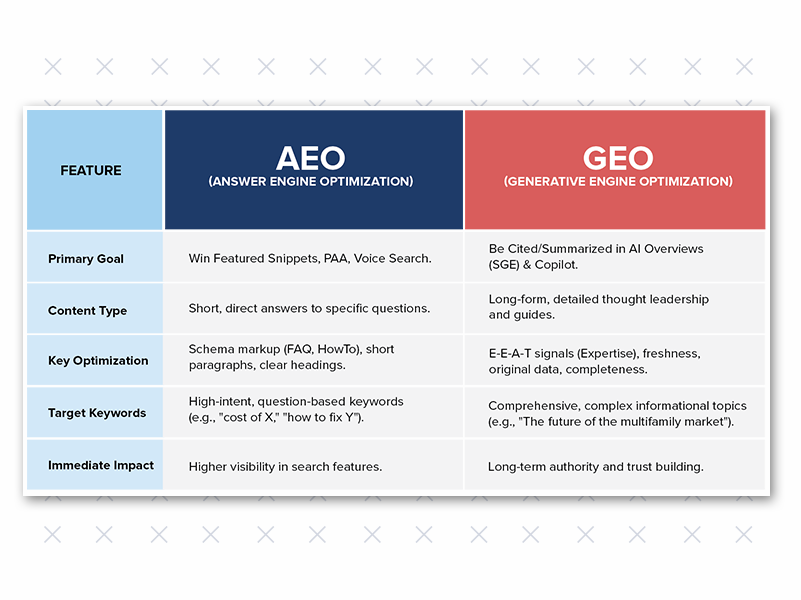
AEO and GEO serve fundamentally different purposes in modern SEO. One is a tactic for instant visibility; the other is a strategy for long-term relevance.
Building a Unified Strategy for 2026
You don’t need to choose one or the other. In fact, a modern SEO strategy requires both. AEO helps you win high-visibility spots for quick answers, while GEO builds lasting trust and relevance.
When to Prioritize Each Approach
Use AEO when:
- You want quick visibility for specific, question-based queries.
- You are creating short-form content like FAQ pages or support articles.
- You are targeting keywords that currently show featured snippets or “People Also Ask” boxes.
Use GEO when:
- You are building brand authority or competing on informational depth.
- You are publishing long-form guides, evergreen content, or complex industry breakdowns.
- The goal is for your organization to be seen as the definitive expert on a topic.
Key Mistakes to Avoid
- Treating them as mutually exclusive: Your content should use both strategically. For example, your comprehensive (GEO) guide can include an FAQ section optimized with schema (AEO).
- Optimizing for machines at the expense of humans: AI models favor content that is written well for real people. If your content reads like it was built for an algorithm, you’ve missed the point.
- Ignoring content freshness (GEO Killer): AI models prioritize current information. If your comprehensive guide hasn’t been updated in two years, it won’t be cited. Schedule regular reviews and content refreshes.
The digital information environment will only become more automated. As search continues to evolve, your content must too. Keep it helpful. Keep it credible. And make sure it’s built to show up, whether a human or an algorithm is doing the reading.
Want help optimizing your content for both AEO and GEO to secure your brand’s visibility in the new search landscape? Get in touch with our team today.
Subscribe to Blog
Related Blog Posts