
Your traffic is down. Your leads are not.
That gap quietly growing in dashboards across multifamily marketing teams right now is one of the most misunderstood signals in the industry. And how you interpret it over the next 12 months will likely determine whether your brand keeps pace with where consumer behavior is actually going, or keeps chasing metrics that no longer mean what they used to.
Here’s what’s happening: a prospective renter opens ChatGPT or Google’s AI Mode and types something like, “Find me a pet-friendly apartment in Austin with a rooftop deck under $2,500.”
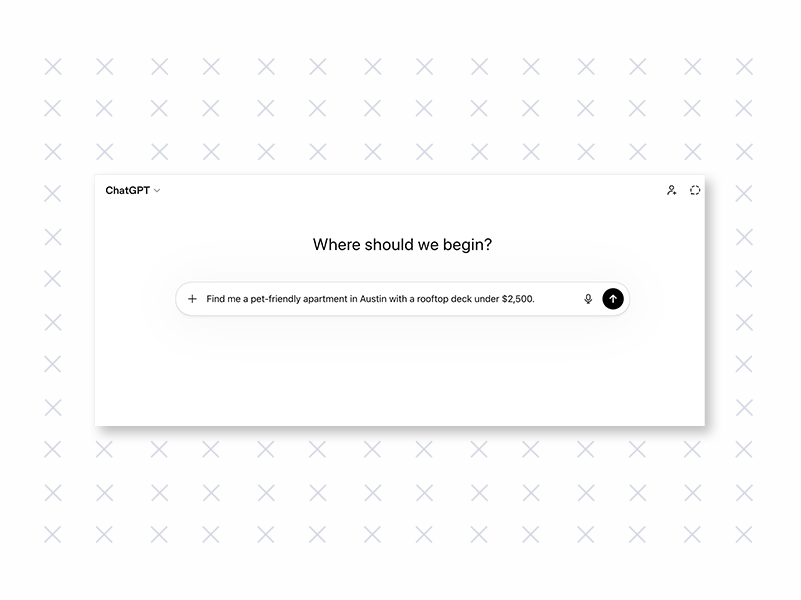
The AI reads thousands of data points (review platforms, local citations, Google Business Profiles, structured content across the web, etc,.) and surfaces three or four recommendations. If your property is optimized across these signals, it becomes one of them, complete with a phone number and a summary of what residents say about living there.
The prospect calls your leasing office directly without touching your website.
Over time, your Google Analytics shows a decline and your marketing team panics.
But nothing is broken. In reality, your brand is working.
The Zero-Click Era Is Already Here
This isn’t a trend coming down the road. It’s already the default behavior for a growing slice of your prospect pool.
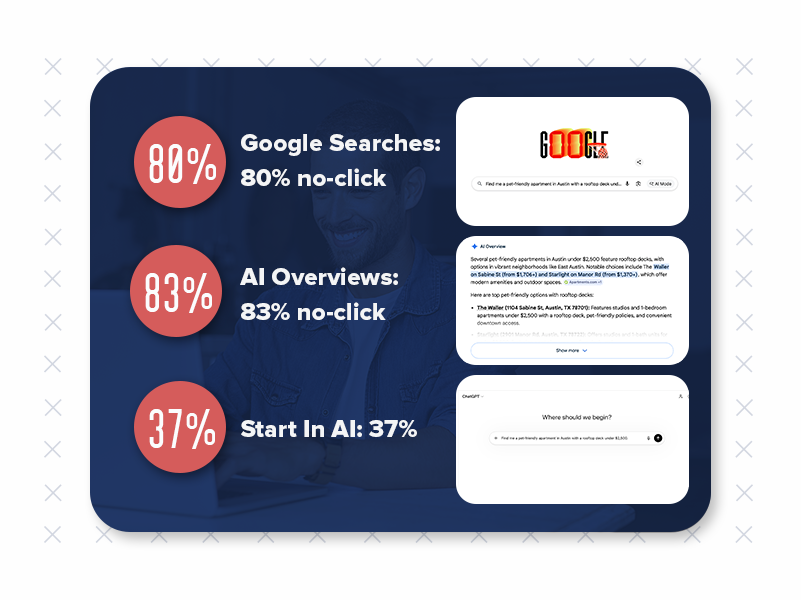
In 2026, 80% of Google searches end without a click to any external website. For queries that trigger AI Overviews, the kind of intent-driven searches that include “best apartments near downtown Denver”, that zero-click rate climbs to 83%. On mobile, 77% of all queries end before the user ever leaves the search interface.
Meanwhile, 37% of consumers now start their searches with AI tools rather than traditional search engines. Half of all consumers are already using AI-powered search in some form, cutting across every major demographic, including Baby Boomers.
What this means for multifamily: the search funnel your entire marketing infrastructure was built around — impression, click, session, lead — has a new top layer. And most teams have no visibility into it whatsoever. (If you’ve been wondering whether the traditional funnel is still relevant at all, we’ve written about that too.)
Your Analytics Are Lying to You (Sort of)
Not intentionally. But they’re missing something critical.
When a prospect discovers your property through an AI recommendation and then clicks on the link or searches your brand name to find your website, those sessions show up in GA4 as direct traffic. No source, no medium, no campaign attribution.
Research now shows that 70.6% of AI-referred traffic lands in analytics as “Direct.” It’s invisible to your standard reporting. Industry analysts are calling it dark traffic, and it’s piling up in your dashboards right now, quietly credited to nothing.
Here’s the part that should reshape your next budget meeting: that dark, AI-referred traffic converts at a 10.21% transactional rate, compared to 2.46% for non-AI traffic.
The people who find you through an AI recommendation aren’t browsers, they’re buyers. And you have almost no idea how many of them there are.
Citation Share: The Metric That Actually Reflects Reality
Website traffic measures who came to you. Citation share measures how often AI is talking about you.
When a prospect asks an AI a question relevant to your community, how often does your property show up in the answer? Not just as a link, but as a named recommendation with context that drives a direct phone call. Think of it like share of voice, but for AI-generated responses. If ChatGPT recommends three communities when someone asks about luxury apartments in Nashville and yours is one of them, you own roughly 33% of that answer’s citation share.
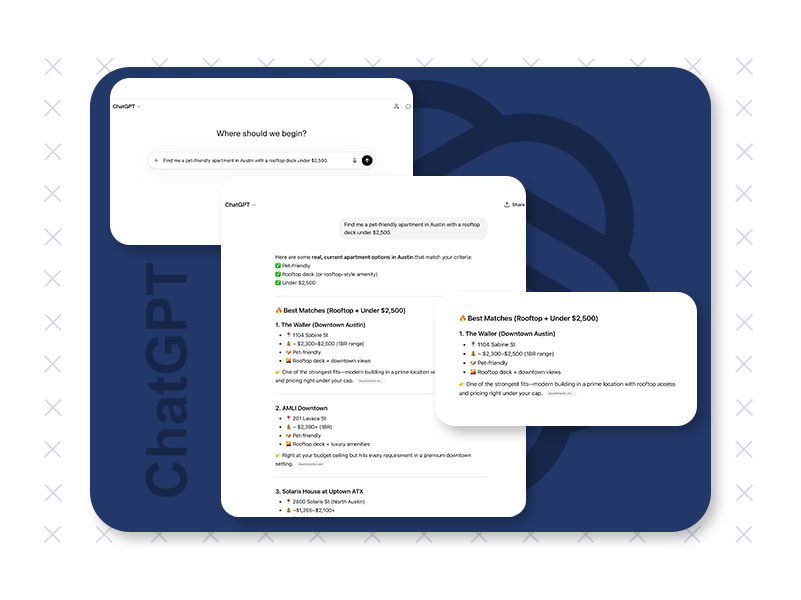
The operators appearing consistently in AI responses are building a compounding advantage. The ones who aren’t are losing ground they may not even realize.
What AI Is Actually Reading When It Decides to Recommend You
Understanding citation share starts with understanding what feeds AI recommendations in the first place.
AI search engines (ChatGPT, Google’s AI Mode, Perplexity, Gemini) are synthesizing information from a wide ecosystem: Google Business Profiles, review platforms like Google Reviews and ApartmentRatings, structured data on your property website, local directory listings, press mentions, blog content, and social proof signals.
The communities showing up consistently in AI responses share a few characteristics:
- Review volume and recency matter more than ever. AI models weigh fresh, specific, high-volume review data heavily. A community with 120 Google reviews and consistent 4.5+ ratings is significantly more likely to be surfaced than a comparable community with 80 reviews from two years ago.
- Structured, specific content wins. Vague website copy (“a premier living experience”) gives AI nothing to work with. Specific, structured content (“pet-friendly community with a 4th-floor rooftop deck, walk score of 92, and 24-hour maintenance response”) is exactly what AI parses and cites.]
- Citations across platforms compound. Consistent information across Google Business Profile, Apple Maps, Bing Places, Yelp, ApartmentList, and niche directories creates the kind of cross-platform signal coherence that AI models use to verify and surface a brand confidently. Messy or conflicting data across platforms does the opposite — here’s a deeper look at why that matters.
From Traffic Generation to Brand Discoverability (Where to Start)
For most multifamily marketing teams, the model has been: more content drives more traffic, more traffic drives more leads. That isn’t wrong, but it’s now incomplete.
The emerging frame is brand discoverability: how easily can AI find, understand, and accurately represent your community when a prospect asks a relevant question?
This new discipline is called Generative Engine Optimization (GEO) or AI visibility — the practice of structuring your digital presence specifically to be surfaced and cited by AI systems. It’s adjacent to traditional SEO but meaningfully different in its priorities. SEO optimizes for ranking. GEO optimizes for citation.
Practical starting points:
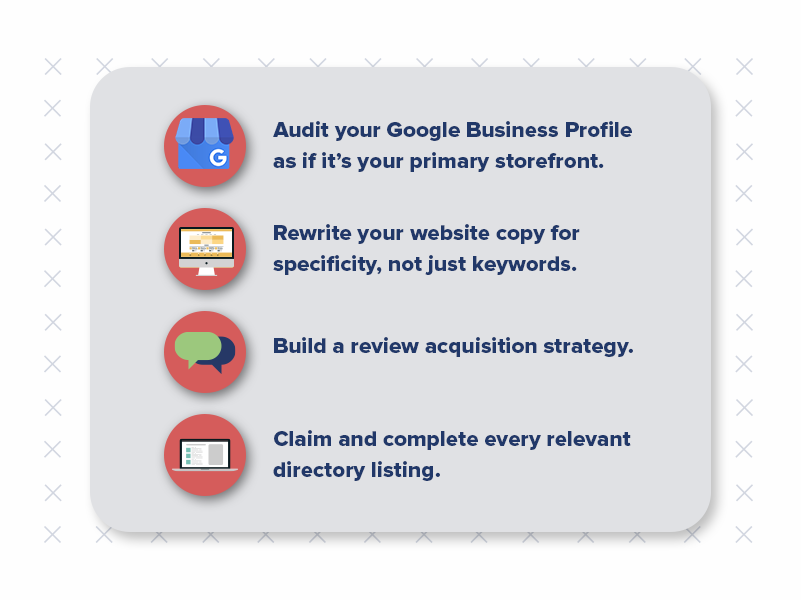
- Audit your Google Business Profile as if it’s your primary storefront. Complete every field. Update it monthly. Respond to every review, because AI reads your responses as much as the reviews themselves.
- Rewrite your website copy for specificity, not just keywords. Every unique feature, amenity, location advantage, and proof point should be stated clearly and directly, in language a prospect would actually use to search for it.
- Build a review acquisition strategy. Not a review incentive program — a systematic process for asking satisfied residents at the right moment. Volume and recency are the two variables that matter most.
- Claim and complete every relevant directory listing. Consistency of information across platforms is a trust signal for AI. Inconsistent NAP data (name, address, phone number) creates ambiguity that pushes AI toward recommending competitors.
The Prospect Has a Personal Shopper Now. Is Your Brand On the List?
Here’s the mental model worth carrying into your next planning cycle: your future renter is increasingly using AI as a personal shopping assistant. They’re not browsing. They’re delegating the shortlist to a tool that’s going to read everything publicly available about your community and decide whether you deserve a recommendation.
That tool doesn’t care about your paid search spend. It doesn’t care about your banner ad impressions. It cares about the quality, consistency, and specificity of your brand’s digital footprint across every platform where information about you exists.
The operators who build for that environment now will be the ones showing up in AI responses when intent is highest — not just visible, but recommended, summarized, and handed directly to a prospect who’s already ready to call.
That phone call that came from nowhere? It came from everywhere. You just couldn’t see it yet.
Share This Article


Subscribe to our newsletter
Related Blog Posts