

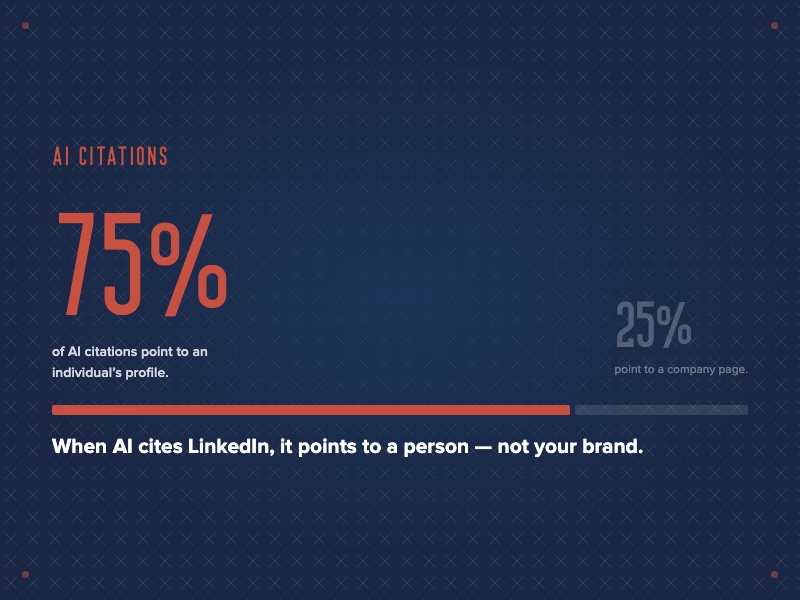
Here is a number that should reorganize how you think about your content. When AI assistants generate an answer and cite LinkedIn as a source, 75 percent of those citations point to an individual’s profile. Only 25 percent point to a company page.
Read that again. The machines that are supposedly flattening everything into corporate sameness have a clear preference, and it is not for your brand. It is for a person who actually knows something.
The Trap Everyone Is Walking Into
The instinct right now is to point AI at the content problem and let it run. Produce more, faster, cheaper. Blog posts, listing descriptions, email nurtures, social captions, all spun up from a prompt in the time it takes to refill your coffee.
The problem is that this is the exact moment the entire industry is doing the same thing. When your competitor can produce the same volume from the same tools, volume stops being an advantage. Worse, the rush to automate has a hidden cost: it buries the one asset AI cannot copy. Somewhere in your organization is a leasing manager who has signed two thousand leases and can tell you the real reason people say yes. There is a regional who has taken eight communities through lease-up and knows which amenities photograph well and never get used. That knowledge is not in any training set. And most operators are actively hiding it behind an anonymous, polished brand voice that sounds like everyone else.
The Reframe: AI Raised the Floor, Which Made the Ceiling Human
Think of it this way. AI has made competent content free. The floor for “good enough” writing is now something anyone can hit in seconds. That sounds like bad news for anyone who produces content. It is actually the opposite, because when execution becomes a commodity, the value moves up the stack to the thing that was always hard: knowing what is true from having lived it.
Google put a name on this before most people were paying attention. Its content quality framework used to be E-A-T: Expertise, Authoritativeness, Trustworthiness. A few years ago it added a second E at the front: Experience. Not “did you research this,” but “were you there.” Did you run the campaign, tour the units, make the mistake, watch how renters actually behave at 6 p.m. on a Saturday. AI cannot fabricate first-hand experience, and both search engines and language models are getting sharper at detecting when it is missing.
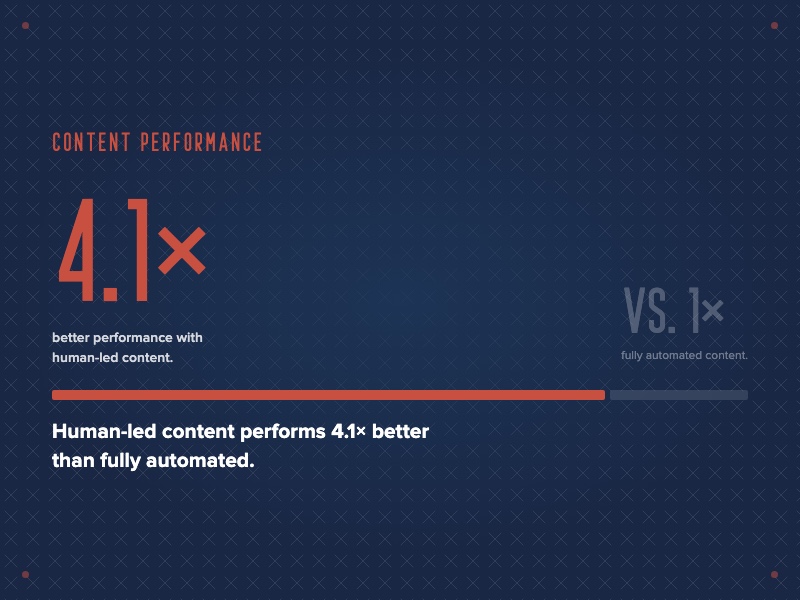
The data backs the strategy. Content built with human strategic oversight performs 4.1 times better than fully automated output. And AI systems, when they go looking for something to cite, overwhelmingly favor identifiable individuals over faceless brands — which is increasingly how your best leads find you in the first place. The expertise your team already holds is not a nice-to-have. In the post-AI landscape it is the single most defensible input you have.
What This Looks Like When You Get It Right
The shift is less about hiring and more about extraction. You are almost certainly already employing the experts. The job is to stop letting their knowledge evaporate in Slack threads and leasing-office conversations, and start turning it into marketing.
Practically, that means:
- Give your content a name and a face. A market-trends post bylined by your VP of Operations, with a photo and a real bio, outperforms the same words published under “The [Property] Team.” The individual is what gets cited, trusted, and remembered.
- Interview your experts instead of briefing a chatbot. Thirty minutes with your best leasing agent, recorded and transcribed, contains more usable, un-copyable insight than a week of prompt engineering. Let AI help you shape and polish that raw material — but the material has to come from a human who was there.
- Publish the specifics only you know. Not “renters value community.” Instead: the exact objection your team hears most on tours, and how you answer it. The renewal tactic that lifted retention. The thing about your neighborhood that no listing site captures.
This is where AI belongs in the workflow — as the tool that scales and structures human expertise, not the substitute for it. Record the expert, then let the machine transcribe, organize, and repurpose one conversation into a blog, three emails, and a month of social. The expertise is the scarce input. The AI is the multiplier.
Stop Managing Content. Start Mining Expertise.
The uncomfortable question for your next planning meeting is not “how do we make more content?” It is “whose knowledge are we wasting?”
Most multifamily organizations treat their marketing team as producers and their operators as a separate world — the people who actually run the buildings. In the post-AI landscape those worlds have to merge. Your marketing team’s highest-value job is shifting from writing copy to mining the expertise sitting three doors down and putting a credible human name on it. That is a different skill set, a different workflow, and a different way of measuring what a content hire is for.
It also changes how you get found. As renters increasingly start their search inside AI assistants, the content that surfaces and gets cited is the content that reads as though a real expert stood behind it. Anonymous brand copy is exactly what these systems discount.
The Close
For a decade, the goal of content was to sound like a brand. In the next decade, the goal is to sound like a person who genuinely knows the thing, because that is the only signal AI cannot manufacture and the only one your audience, and the algorithms serving them, have learned to trust.
The best marketing tool you have is not a tool at all. It is the expertise already on your payroll. The winners will be the ones who stop hiding it.
Share This Article